

Are you wondering if you can afford to live in Uruguay and what various items cost?
Below is a breakdown of what our first month in Uruguay cost us, with updates on how costs have changed five years later, living in a small coastal village.
Please remember that everyone has different lifestyles and eating habits, so this is just an indication based on my husband, myself and our pets.
Another thing to note is that we moved in winter to El Tesoro, a suburb on the coast near La Barra and Punta Del Este. Thus, many things were more affordable than they would be in summer.
For example, in summer, the rental of houses and cars increases, and the cost of food may also increase, depending on where you shop.
And now we live in a sleepy coastal village with a much cheaper lifestyle than in Montevideo or Maldonado.
Let’s take a look at our cost of living in Uruguay.
Renting a House or Apartment
Over the last five years, we initially rented and then, after much searching, finally purchased a house.
2019
In our first house, we paid a winter rental rate of USD 617 with an additional agent’s commission of USD 62 per month for a 3-bedroom home on a small stand in El Tesoro.
If you take an annual rental contract, you can expect to pay a higher monthly rental as you’ll occupy the property during high-season months.
This would not be a significant factor inland, but it impacts rental prices near the coast.
High summer rental prices also mean that many houses are unavailable for annual rental as the owners get substantial rental income in the summer months.
However, you can get annual rentals here from USD 800 per month upwards, depending on the area and the size of the house you are after.
USD 1,000 to USD 1,300 seems to be a good ballpark figure to work on unless you are looking for a large home.
If you use an agent to rent a house, you’ll have to pay them a commission.
From what we have experienced, the commission on annual rentals seems to be 1 month’s rental, thus 8.34%. Commissions differ for shorter rental periods. We’re paying 10% on a 3-month rental term.
There is also a substantial deposit payable upfront when you rent a property. Anything from 3 to 6 months rental.
2024
We left our first rental after 3 months as summer rental prices were looming and managed to secure an annual rental on a rustic cabana in Punta del Este for USD 600 per month.
It was challenging to find a deal like this, as five years ago, most houses with gardens were around USD 1200 per month.
Our next move was to purchase a small house in Aguas Dulces, in the Rocha department. Although we are far from the action, the property here is significantly more affordable.
We no longer have to pay rent, and our annual property rates for the house are only around 10,000 pesos or USD 250.

Electricity and Gas
I have encountered many expats with exceptionally high electricity bills and presume they run air conditioning units or dehumidifiers year-round.
We have not found electricity in Uruguay very expensive, but we use a fireplace for heat in winter and a gas stove for cooking.
2019
Electricity is supplied by UTE, and they send someone to take meter readings every month.
The house we’re renting has a gas stove but no fireplace for heating, only dual-function air-conditioners.
The cold only arrived in the last week of June, so we did not use them much in our first month.
Our electricity bill for the month was 1,450 pesos. This will probably be higher in July as we are now using the air-conditioners to heat the house.
2024
We are on the UTE simple plan, and our electricity bill averages around 1,600 pesos monthly.
Over the last five years, we have never had a bill over 2,600 pesos, but as mentioned, we don’t use air conditioners, dehumidifiers or an electric oven.
However, our firewood bill ranges from 4,000 to 6,000 pesos over winter, and that’s only for fires in the evenings, not throughout the day.
Next winter, I plan on using a heater for a month to see if it increases my bill by more than 1,000 pesos.
We use gas for cooking, and a 13kg gas bottle lasts approximately three months.
Five years ago, when we were in our second house in Punta del Este, a gas bottle refill cost approximately 690 pesos with delivery. Now we’re paying 1,100 pesos for a refill and delivery.
Water
We were fortunate not to experience significant problems with the water shortage last year and find the cost of water in Uruguay very reasonable compared to South Africa.
2019
The houses in Uruguay’s residential areas all have drinkable water supplied by OSE.
There’s a water meter at the house, and OSE comes and takes the reading every month. The house we’re renting has showers and no baths, which saves on water.
We used water for showering, washing dishes, cleaning floors and washing clothes. The two of us used 5 cubic meters of water last month, and the bill for this was 535 pesos.
2024
Nothing much has changed. We are still connected to OSE mains water and use around 5 cubic meters of water in winter.
However, I now have a garden, and in summer, I use OSE water for irrigation. This increases the bill to around 900 pesos.
Wifi and Cell Phones
Who can live without their cellphone and when you are far away from loved ones a good internet connection is vital.
Here’s a breakdown of our connectivity costs.
2019
Reliable connectivity is essential for me, and the house we are renting has a wifi router and a contract through Antel. The cost of this is 1,255 pesos per month.
I am happy with the speed and connectivity of this connection. It seems to be better than what I had in South Africa.
Fiber optic Internet connectivity with impressive speeds is also available in larger cities,
We brought our cell phones from South Africa and have inserted Uruguayan pay-as-you-go sim cards.
We’re using an Antel card on one phone and a Moviestar card on the other. This allows us to check the difference in connectivity of these service providers in the various areas we travel to.
Both service providers allow you to buy monthly or weekly pay-as-you-go packages depending on your requirements. In our first month, our cell phone costs were 1,120 pesos.
2024
During our stay at the cabana in Punta del Este, there was a problem with the Antel line, and I discovered that using my cell phone as a hotspot with Movistar was perfect for my internet.
When we moved to Aguas Dulces, we did not install an Antel line as the connectivity of theri line was very sporadic.
Fortunately the Movistar connectivity was still fast enough for video calls and zoom meetings so we now both use Movistar and have data packages that give us 90 gigs for around 1,100 pesos per month.
Fiber optic cables have just been installed in Aguas Dulces so I am going to apply and will update this post when these are installed.
Transport
The bus service in Uruguay is excellent, and we have been using buses to get around.
2019
Our transport costs in June were 2,662 pesos for two people. This amount includes 450 pesos we contributed towards petrol when we traveled with friends to remote functions.
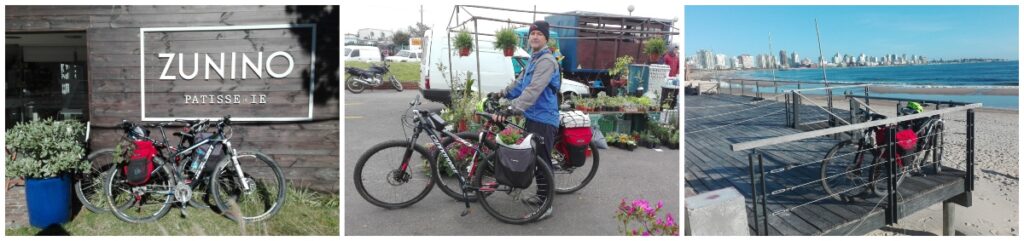
We’re saving money on transport by cycling and walking to as many locations as possible.
We brought our bicycles from South Africa and used them for most short trips under 10 km. Our local shops are also within walking distance.
We know of South Africans renting cars monthly, and the rate for this starts from USD 430 per month for a small, entry-level car and goes up from there depending on the model you take and the time of year.
As we have not hired or purchased a car yet, we do not have information on the price of petrol, car insurance or license fees.
2024
We are still using buses to get around unless we plan a trip to a remote location, in which case we hire a car.
But as we would like to participate in mountain bike races and hikes in remote areas, inaccessible by bus, we are looking at purchasing a car in the near future.
Food and Other Household Supplies
The cost of food will vary substantially from person to person based on how and what you like to eat and where you shop.
There are various shopping options, from local fresh produce markets to large supermarkets that stock imported products and everything in between.
I have found that processed, packaged food, like cereal, is much more expensive than what I am used to, but fresh fruit and vegetables, as well as red meat, are similarly priced and sometimes cheaper depending on where you shop.
The shops also often have specials running, making items much more affordable.
2019
In June 2019, we spent:
- 13 745 pesos on food and condiments
- 2 910 pesos on snacks, chocolate, and pastries (clearly not being very healthy)
- 1 755 pesos on red wine (our drink of choice)
- 1 008 pesos on toiletries
- 1 860 pesos on cleaning supplies for both laundry and house
2024
I have not done an itemized breakdown of my spending for a while, but generally, I budget 3000 pesos per week for food.
Our toiletries and cleaning supplies are significantly less now as we purchase these items in Chuy.
Pets
Not everyone has pets, so this may not be something you need to budget for.
2019
We have three dogs and two cats who traveled to Uruguay from South Africa.
Our expenses in the first month are for a cat litter box, cat litter and dog and cat food.
I purchased large bags of dog food that may last until the end of July. Thus, 5,494 pesos for the month may seem high, but it covers more than a month.
2024
We have increased to four dogs and two cats and had to try different foods to find one that works for the dogs and our budget.
We also have a bird feeder and enjoy watching the birds that visit our feeder. Interestingly, it changes seasonally as some species are only around in summer.
Currently, we spend approximately:
- 2800 pesos on dog food
- 1000 pesos on cat food
- 480 pesos on wild bird seed

Medical
We are impressed with the medical system in Uruguay and feel confident that we can get quality healthcare when needed.
We pay to be members of a mutualista, but I know many people who have received quality care at government hospitals.
2019
Once we had our temporary resident cedulas, I opened a Monotributo, and we joined Mautone Mutualista using Fonasa.
The service and attention we received were exceptional, and due to an accident my husband suffered, we had a chance to test out their emergency rooms, operating theaters, staff and plastic surgeons.
The experience was fabulous from beginning to end, with very low co-payments.
We also paid a monthly subscription of 250 pesos to Cardio Movil as we did not have a vehicle. Their doctors make house calls and will get you to a hospital if you need emergency care or to be hospitalized.
2024
When we moved departments, we changed Mutualista to Comero, the private healthcare provider in Rocha.
Fortunately, we’ve had no reason to test out their operating rooms. But we have seen doctors and visited the local emergency room a handful of times.
The cost of this is included in the monthly BPS payment for my Monotributo, and when we moved, we had to notify BPS of the change.
Banking
We opened an Itau account as they are one of the easiest banks for expats to open an account.
We have found their service excellent, and I have no complaints except for the exceptionally high monthly fees.
Locals pay USD 20 per month, but foreigners pay USD 40 per month, and you can only reduce these fees if you prove that your income is generated in Uruguay.
You can open a BROU savings account with very low to no monthly fees, but I understand their fees for bringing money into the country are very high.
I hope this information has been helpful. Although many items in Uruguay are expensive, vital things like adequate medical care and feeling secure are not.
Also, if you shop like locals and eat local seasonal produce, it helps to reduce costs.
To learn more about life in Uruguay, browse some of my latest Uruguay Insights Newsletters.